Water Overflow: The Hidden Cost in Indian Households
Tank overflow is not just wasted water, it drives up your electricity and repair bills. Here is what it actually costs, and how to stop it for good.
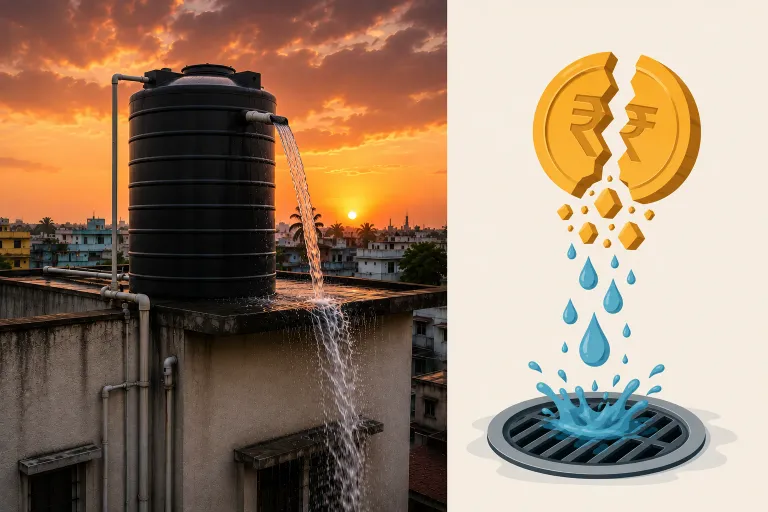
The scene is familiar. The motor runs, the tank fills, and at some point, whether because nobody was home, or someone forgot, or the float valve failed, water starts pouring off the roof. It runs down the walls, soaks the ceiling of the floor below, and disappears into the drain.
Most households treat this as an inconvenience. The actual cost tells a different story.
How Much Water Overflows in a Typical Indian Home?
Let’s start with the basics. A standard domestic overhead tank holds between 500 litres and 2,000 litres. For a family of four in a city like Hyderabad or Bangalore, daily water consumption is approximately 500–700 litres.
A 1HP pump typically delivers 1,500–2,500 litres per hour. If your tank capacity is 1,000 litres and your motor runs for even 15 minutes after the tank is full, you have lost:
15 minutes × 1,500 LPH = 375 litres
That is approximately 37% of the tank’s capacity, gone in a quarter-hour of inattention.
For households that experience overflow regularly, say, three or four times per week, the numbers add up quickly:
| Scenario | Water Wasted Per Week |
|---|---|
| 4 overflow events × 100 litres | 400 L |
| 4 overflow events × 250 litres | 1,000 L |
| 4 overflow events × 375 litres | 1,500 L |
At Hyderabad’s residential water tariff (approximately ₹3–5 per 1,000 litres for metered supply), water cost alone may seem minimal. But the electricity cost is where it stings.
The Electricity Cost of Running an Overflowing Motor
A 1HP motor draws approximately 0.75–1 kW of power. In Telangana, the residential tariff in the 201–400 units/month slab is approximately ₹4.50–₹6.50 per unit (kWh).
If your motor runs an extra 30 minutes per day beyond what’s needed, which is modest for a home with overflow issues, the additional consumption is:
0.75 kW × 0.5 hours × 365 days = 137 kWh/year
At ₹5.50 per unit: 137 × 5.50 = ₹754/year in unnecessary electricity cost.
For homes where the motor runs for hours overnight while the tank overflows, this number can exceed ₹2,000–₹3,000 per year.
Structural Damage: The Cost Nobody Calculates
The financial cost most households never accurately attribute to water overflow is structural damage.
Chronic water overflow, water running down exterior walls, pooling on flat roofs, seeping through gaps, causes:
Seepage and damp walls: Water penetrates through cracks in plaster or cement, causing paint to bubble and peel. Fixing damp patches costs ₹500–₹3,000 per wall, depending on severity. In a multi-floor building, water from the roof tank can travel two or three floors down.
Ceiling damage: If the tank is located above a habitable room (common in apartments), overflow water collects on the ceiling slab. Repairing a water-damaged ceiling, patching plaster, waterproofing, repainting, costs ₹2,000–₹10,000 per incident.
Mould and mildew: Persistent dampness creates the conditions for mould growth, which presents health risks and requires professional remediation.
Structural integrity: Over years, repeated water infiltration into concrete and brick weakens the structure. This is a long-term risk that’s difficult to quantify but real.
A conservative estimate for a home that experiences moderate overflow: ₹5,000–₹20,000 in structural maintenance over five years that would not have occurred without the water damage.
The Hidden Enabler: The Float Valve That Fails
Most homes rely on a plastic float valve inside the tank to shut off the inflow when the tank is full. It has no control over the motor. These valves are mechanical, a float on a lever arm that closes a valve when it reaches a certain height.
Float valves have two common failure modes:
-
Stuck open: The float or valve mechanism gets stuck, allowing water to continue flowing past the “full” level. The motor keeps running. The tank overflows.
-
Stuck closed: The valve closes too early, preventing the tank from filling properly. You run out of water.
A float valve costs ₹50–₹200. It fails silently, you don’t know it has failed until you find water running down the wall, or discover the tank was never filling properly. Replacing one requires draining the tank or climbing to the terrace, which is another reason many households simply tolerate the problem.
The Simple Fix
Preventing overflow requires two things:
- A sensor that reports when the tank is actually full, not a float valve that can stick open, but a sealed level sensor wired to a controller.
- A controller that cuts power to the motor the moment the tank reaches full, automatically, every time, without human intervention.
That is precisely what an automatic water level controller does. The moment the tank level reaches the Full sensor, the motor relay opens and the pump stops.
The motor never runs past Full. Water never goes over the edge.
Putting the Numbers Together
Here is a conservative annual cost estimate for a home with moderate overflow issues:
| Cost Category | Annual Estimate |
|---|---|
| Extra electricity (motor running past full) | ₹500–₹2,000 |
| Water bill (if metered municipal supply) | ₹200–₹800 |
| Structural maintenance (amortised) | ₹1,000–₹4,000 |
| Float valve replacements | ₹200–₹600 |
| Total avoidable cost | ₹2,000–₹7,400/year |
At ₹12,999 for the entry SwitchFlo model, these overflow savings alone cover the controller in roughly two to six and a half years, before counting the motor wear that dry-run protection also avoids. Our guide to what a water level controller costs in India shows where that price sits against cheaper options.
A Note on Water Scarcity
Beyond the financial case, there is an environmental one. India faces a serious and worsening water crisis. Major cities already experience water stress. Groundwater tables in many urban areas are falling year after year.
Wasting hundreds of litres of treated, pumped water every week, water that required energy to supply, store, and pump, is not a trivial matter. Smart water management is one of the simplest ways a household can reduce its water footprint without changing its lifestyle at all.
The motor stops when the tank is full. That is a solved problem. It simply requires the right hardware to implement it reliably.
SwitchFlo includes overflow prevention in all models. The Full sensor is set at your tank’s maximum safe level during installation. The system works in Auto mode continuously, you never have to remember to switch the motor off again.
Automate your water system with SwitchFlo
Dry-run protection, overflow prevention, and mobile app control. Starting from ₹12,999 with free shipping across India.
Explore SwitchFlo