Why Your Water Pump Burns Out (And How to Prevent It)
Learn the hidden causes of water motor failure like dry-running, and how a smart water controller can save you thousands in repairs.
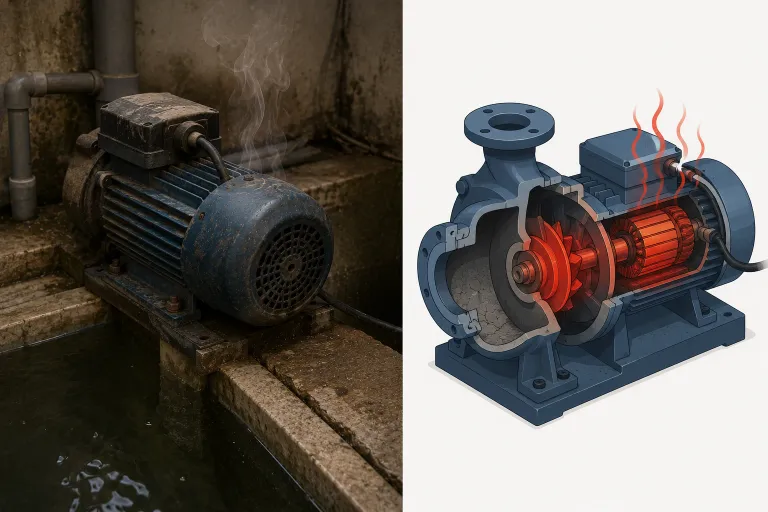
Water pump failure is one of the most common, and most preventable, household expenses in India. A typical domestic motor costs between ₹5,000 and ₹15,000 to replace, and many homes replace theirs every one to three years. If that sounds familiar, the root cause is almost certainly one of the five problems described below.
What Is Dry-Running?
Before we get into the causes, it helps to understand the most destructive failure mode: dry-running.
A water pump is designed to move liquid. The liquid, water, also acts as a lubricant and coolant for the motor’s internal components. When your motor runs without water, there is nothing to cool or lubricate those components. The heat builds rapidly. Within seconds to minutes, the internal windings can overheat, the rubber seals can melt, and the motor can seize permanently.
In India’s typical sump-and-overhead-tank setup, dry-running happens when:
- The sump runs out of water and nobody notices
- The motor is left running on a manual switch after the tank is full
- A schedule is set incorrectly and the motor runs at 4am when the sump is empty
The damage is not gradual. It is often sudden and total.
The 5 Causes of Motor Failure in Indian Homes
1. Dry-Running (the most common)
As described above. The sump empties, the motor runs in air, the windings burn. This is responsible for the majority of premature motor replacements in Indian households.
Signs: Motor smells of burning, makes a high-pitched whine, or trips the MCB repeatedly.
2. Voltage Fluctuations
India’s grid supply is rated at 220–240V, but in many localities, especially during peak hours, summer months, or areas with weak infrastructure, voltage can dip below 180V or spike above 260V.
Running a motor outside its rated voltage range causes:
- Low voltage: the motor draws higher current to compensate, overheating the windings
- High voltage: insulation breakdown, capacitor failure, winding shorts
Signs: Motor runs slowly, feels hot to touch even shortly after starting, or trips with a burning smell.
3. Frequent Short-Cycling
Short-cycling means the motor starts, runs briefly, stops, then starts again almost immediately. Each startup draws 3–6× the motor’s running current (the “inrush” current). If this happens dozens of times per day, the thermal and mechanical stress accumulates rapidly.
This typically happens when:
- The float valve is set incorrectly and tanks alternate between full and nearly full
- The level sensor is mounted at the wrong height
- A partially blocked pipe causes pressure fluctuations
4. Water Hammer
Water hammer is the pressure shock that occurs when water flow is suddenly stopped, usually by a check valve closing or a tap being shut off while the pump is running. The shockwave travels back through the pipe and into the pump.
Over time, water hammer damages the pump’s impeller, seals, and check valve. It is more common in vertical multistage pumps but affects submersible pumps too.
Signs: A loud banging or thudding sound when the motor stops.
5. Running Continuously With a Closed Valve
If someone runs the motor with a valve downstream closed (accidentally or deliberately), the motor circulates water internally with nowhere to go. Pressure builds inside, temperature rises, and cavitation, the formation and violent collapse of vapour bubbles, erodes the impeller.
What Dry-Run Protection Actually Does
Dry-run protection watches the motor’s water source. When the sump or borewell runs empty, it cuts power to the motor before damage can occur.
Traditional float switches do provide some protection, but they have limitations:
- Mechanical floats wear out and stick
- They don’t respond to the actual motor condition, only to tank level at a fixed point
- They can’t detect water hammer or partially blocked pipes
Electronic dry-run protection, like what’s built into SwitchFlo, gives each motor its own dry-run sensor at that motor’s water source, with the decision made by the controller. When the source runs empty, the controller waits for a confirmation delay you set in the app, so a borewell that is slow to prime does not cause false trips, then cuts power and sends a push notification to your phone.
The Real Cost of a Burnt Motor
Let’s run the numbers for a typical household:
| Item | Cost |
|---|---|
| Domestic pump replacement (1HP) | ₹5,000–₹12,000 |
| Plumber / electrician labour | ₹800–₹2,000 |
| Downtime (water not available) | 1–3 days |
| Total per incident | ₹6,000–₹15,000 |
For a home that burns out a motor every 18–24 months, that’s ₹3,000–₹8,000 per year in avoidable expense.
A SwitchFlo controller starts at ₹12,999 and includes a 1-year replacement warranty against manufacturing defects. Set against the ₹6,000 to ₹15,000 a single burnt-out motor costs in the table above, avoiding one replacement covers somewhere between almost half and all of that price. For how that compares with basic controllers, see what a water level controller costs in India.
The Simple Fix
The simplest, most reliable way to prevent dry-run damage is to use a controller that:
- Monitors tank levels in real time
- Stops the motor automatically when its water source runs dry
- Alerts you on your phone so you know what happened and why
- Lets you reset it with one tap in the app, or one button press, once the source has water again
That is exactly what a water level controller with dry-run protection does, and SwitchFlo does it continuously, 24 hours a day, whether you’re home or not.
If your motor has burned out more than once in the past three years, dry-running is almost certainly the cause. A smart water level controller with dry-run protection addresses the root problem rather than treating the symptom.
SwitchFlo is designed and manufactured in Hyderabad, India. It works with single-phase and three-phase domestic pumps and is installed at your electrical panel by a professional.
Automate your water system with SwitchFlo
Dry-run protection, overflow prevention, and mobile app control. Starting from ₹12,999 with free shipping across India.
Explore SwitchFlo